Yes, many robotic pool cleaners can climb walls, but not all models are designed to do so. Wall climbing ability depends on the cleaner’s propulsion system, traction, and water flow management. Most modern robotic cleaners use tracks or wheels combined with a strong suction or a scrubbing brush system to adhere to vertical surfaces. However, factors like pool surface texture, water chemistry, and the cleaner’s design determine whether it can actually scale a wall and clean the waterline effectively.

Pros
- Cordless operation eliminates tangled cords and manual hose setup
- Wall and waterline scrubbing reduces hand-scrubbing effort
- Long 150-minute runtime covers large inground pools in one cycle
- Top-load filter basket simplifies debris removal and cleaning
- Auto-docking and quick-drain make retrieval convenient
Cons
- No remote control or app scheduling, so operation is limited to one-button mode selection
- At 26 pounds, the unit is still fairly heavy to lift out of the pool despite the quick-drain design
- Customer feedback is limited at this time, so long-term reliability is not yet independently verified
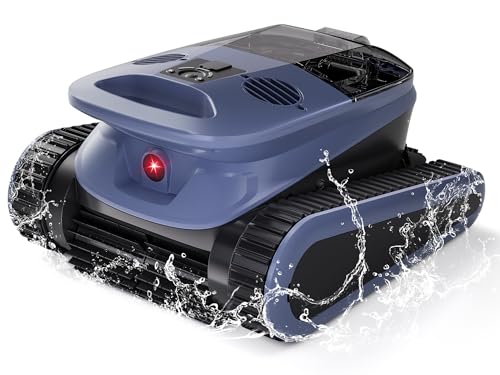
The EZIOOV U8 is a cordless robotic pool cleaner built for owners of medium to large inground pools up to 2,600 square feet. It is designed for anyone who wants automated cleaning of the floor, walls, and waterline without dragging hoses or spending weekends brushing. With a 150-minute runtime, the U8 can handle weekly maintenance in a single charging cycle.
The standout feature is wall and waterline scrubbing. Triple brushless motors and strong traction allow the robot to climb surfaces and remove grime, oil, and stuck-on debris that usually requires hand work. Gyroscope and ultrasonic sensors help it follow efficient paths and avoid obstacles while covering deep ends, corners, and ladder areas.
The 26-pound body feels solid in the pool, and the quick-drain design makes lifting easier after the cycle ends. Its 4-liter top-load filter catches fine dirt, sand, leaves, and larger debris, and you can empty the basket without turning the unit over. The carbon black finish looks clean, and a simple one-button control keeps the experience straightforward.
The main limitations are the lack of remote control or app scheduling and the unit's weight when removed from a deep pool. You choose a mode by pressing the button and let the robot do its work, but there is no way to steer it manually. Since this model has limited customer feedback available, long-term durability is not yet verified by extensive real-world use.
For pool owners who prioritize cordless freedom, wall scrubbing, and a long runtime, the EZIOOV U8 is a strong option. It simplifies routine maintenance and eliminates the tangles and setup of corded units. If you have a larger inground pool and prefer one-button automation, the U8 is worth serious consideration.



How Robotic Pool Cleaners Climb Walls
Robotic pool cleaners climb walls using a combination of physical grip and hydraulic force. Models with rubber tracks or angled wheels create friction against the wall surface. At the same time, the pump inside the cleaner generates a high flow of water, which pushes the unit against the wall, creating a seal that prevents it from sliding back down.
The cleaner’s internal computer controls the direction and speed, allowing it to drive up the wall and even flip over to also clean the waterline. This dual action is what makes wall climbing possible for most mid-range and high-end robotic cleaners.
Types of Wall Climbing: Vertical vs. Sloped Walls
Not all walls are created equal. Some pools have steep vertical walls, while others have gradual slopes. A robotic cleaner that can climb a 90-degree vertical wall needs more suction power and better traction than one that only needs to navigate a 45-degree slope.
Most robotic cleaners marketed as wall climbers can handle walls up to 90 degrees, provided the surface is smooth (like tile or fiberglass). Rough surfaces like plaster or gunite can actually help with grip, but they also wear down tracks faster.
Factors That Affect Wall Climbing Performance
Several factors determine whether a robotic pool cleaner can climb your pool walls. The most important is the cleaner’s power and design. Stronger pumps and longer scrubbing brushes generally improve wall adhesion. The type of tracks or wheels also matters: continuous rubber tracks offer more grip than individual wheels.
Pool surface texture is another factor. Smooth, slippery surfaces like vinyl or painted plaster can reduce traction. Water flow and debris load also play a role: if the cleaner is clogged or the pump is weak, wall climbing may fail. Finally, the angle of the wall and the water depth can affect the cleaner’s ability to reach the waterline.
Why Some Robotic Cleaners Don’t Climb Walls
Not all robotic pool cleaners are designed to climb walls. Budget models often focus only on floor cleaning and lack the water flow or traction needed to scale vertical surfaces. Some cleaners rely on random navigation patterns and may not have the programming to drive up walls intentionally.
If you have a cleaner that is supposed to climb walls but doesn’t, the issue could be a clogged filter, worn tracks, a weak pump, or simply a programming error. Checking the user manual for wall climbing settings can help.
What to Do If Your Robotic Cleaner Won’t Climb Walls
- Check the filter and pump for blockages, debris can reduce water flow and suction.
- Inspect the tracks or wheels for wear and tear, replace if they are smooth or cracked.
- Ensure the pool water chemistry is balanced, high pH or calcium can affect traction.
- Verify that the cleaner is set to the correct cleaning cycle (some have a wall-only mode).
- Test the cleaner in a shallow area first to see if it can climb a small slope.
If none of these steps solve the problem, the issue may be a design limitation of your specific model. In that case, you may want to explore other robotic cleaners that are built for wall climbing. For more information on how different pool cleaners work, you can browse our pool cleaning guides.
Related Guides
- Why Is My Robotic Pool Cleaner Not Climbing Walls
- Can Robotic Pool Cleaners Clean the Waterline?
- Best Solar Pool Cleaning Robot of 2026
Frequently Asked Questions
Do all robotic pool cleaners climb walls?
No, not all robotic pool cleaners are designed to climb walls. Entry-level models typically clean only the floor, while mid-range and premium models can handle walls and waterlines. Always check the product specifications before buying.
Can robotic pool cleaners climb stairs?
Some robotic cleaners can climb stairs, but it depends on the design and angle. Stairs are often steeper and have sharp edges, which can be challenging. Most wall-climbing cleaners can handle gradual steps, but not all can manage a 90-degree stair riser.
How do robotic pool cleaners stick to walls?
Robotic cleaners stick to walls using a combination of suction from the pump and friction from rubber tracks or brushes. The water flow pushes the unit against the wall, creating a seal that prevents it from sliding down.
Can a robotic pool cleaner climb a vinyl liner wall?
Yes, many robotic cleaners can climb vinyl liner walls, but the smooth surface may reduce grip. Look for a model with strong suction and continuous tracks for better performance on vinyl surfaces.
What is the best way to clean the waterline with a robotic cleaner?
To clean the waterline, the cleaner must be able to climb the wall and reach the surface. Most wall-climbing robots have a special waterline cleaning mode that uses brushes to scrub the tile at the waterline.
In summary, yes, many robotic pool cleaners can climb walls, but the ability varies by model and pool conditions. If you are shopping for a new cleaner, look for one that specifically mentions wall climbing in its features. For more tips on choosing the right pool cleaner, visit our blog.